
For years, Google has been the main place people go when they want to find a business, product, service, or answer. Businesses built websites, worked on SEO, created content, and focused on getting their pages into search results.
Google is still important in 2026, but the way people search online is changing.
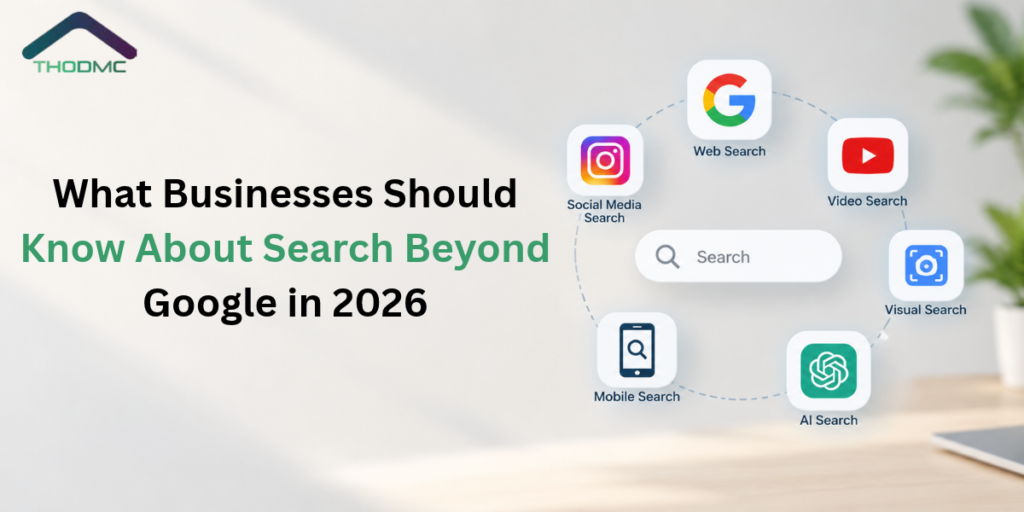
People now use AI tools, social media, video platforms, online communities, maps, and visual search to find information. A person may discover a brand on Instagram, check reviews on Google, watch a YouTube video, ask an AI tool for more information, and visit the company website before making a decision.
This means businesses need to think about search beyond Google.
What Does Search Beyond Google Mean?
Search beyond Google means being visible on the different platforms people use to find information.
Traditional search often starts with a keyword typed into Google. Modern search can start with a question asked to an AI assistant, a product searched on a social platform, a video watched on YouTube, or an image uploaded to a visual search tool.
For example, someone looking for a digital marketing service may:
- Search Google for local agencies
- Ask an AI assistant for recommendations
- Check LinkedIn profiles
- Watch marketing-related videos
- Read reviews and discussions
- Visit an agency’s website
- Compare different companies before contacting one
The search journey can involve several platforms instead of one.
Why Is Search Changing in 2026?
One major reason is the growth of AI-powered search.
Google now includes AI features such as AI Overviews and AI Mode, while people also use standalone AI tools to ask detailed questions. Google’s own guidance says its AI search experiences continue to rely on core Search systems and existing SEO fundamentals.
At the same time, search is becoming more visual and multimodal. In September 2026, Google introduced Search Console reporting for multimodal searches, including Google Lens, Circle to Search, image uploads, and “Search this image.”
So search is no longer limited to a text box and a list of website links.
Where Can People Discover Your Business?
Different platforms serve different purposes. A business does not need to be everywhere, but it should understand where its target customers spend time and search for information.
Google Search and Maps
Google remains an important source for business discovery, especially for local services, products, and informational searches.
A strong website, accurate business information, useful content, reviews, and a properly managed Business Profile can still support online visibility.
AI Search
People are increasingly using AI-powered tools to ask detailed questions and compare information.
This makes clear and useful website content more important. Businesses should explain their services, products, processes, experience, and common customer questions in a way that is easy for both people and search systems to understand.
Google’s current guidance also recommends useful, original content rather than content created only to target search engines.
Social Media Search
Social platforms are also becoming discovery channels.
People may search Instagram, LinkedIn, TikTok, or other platforms to find brands, products, creators, and recommendations. For some industries, a social media profile can be an important part of the first interaction with a potential customer.
This is why social media content should not only focus on promotions. Educational posts, product demonstrations, customer experiences, industry information, and useful short videos can also help people understand a business.
YouTube and Video Search
Some questions are easier to answer through video.
For example, a customer may want to know how a product works, how to use a service, what a process looks like, or what a product installation involves.
Videos can help answer these questions while also creating another way for people to discover a business.
Online Communities and Reviews
People often want opinions from other users before making a decision.
Reviews, discussion forums, community websites, and industry conversations can influence how a business is perceived. Genuine customer experiences can also help people understand what working with a company or using a product is actually like.
This makes online reputation an important part of digital visibility.
Does SEO Still Matter?
Yes.
Thinking beyond Google does not mean leaving SEO behind.
Google’s current documentation states that the same fundamental SEO practices remain relevant for AI-powered search features. Pages still need to be accessible, indexable, useful, and easy for people to navigate.
The difference is that SEO now fits into a wider digital strategy.
Instead of focusing only on:
Keyword → Ranking → Traffic
businesses should also think about:
Content → Visibility → Trust → Engagement → Leads
A page that answers a real customer question can have value even when the visitor does not immediately become a customer.
What Should Businesses Do?
Businesses do not need to completely change their digital strategy overnight. A few practical steps can make a difference.
1. Keep the Website Strong
Your website is still your main online property. Make sure important pages are easy to find, mobile-friendly, technically accessible, and useful to visitors.
2. Create Original Content
Write about real customer questions, industry problems, product details, processes, case studies, and experiences.
Google’s current guidance places importance on unique and valuable content for both traditional and AI-powered search.
3. Build a Presence on Relevant Platforms
You do not need every social media account.
Focus on the platforms that make sense for your audience. A B2B company may benefit more from LinkedIn and industry platforms, while a visual product business may get more value from Instagram, YouTube, or visual search.
4. Keep Business Information Consistent
Business name, contact details, services, location information, product information, and other important details should be accurate across your website and relevant online profiles.
Consistent information makes it easier for people to understand your business.
5. Use Different Content Formats
Do not depend only on blog posts.
Consider:
- Short videos
- Product images
- Guides
- FAQs
- Case studies
- Customer stories
- Social posts
- Industry insights
- Original research
Google’s guidance also highlights the value of supporting text with useful images and videos, particularly as search becomes more multimodal.
6. Track More Than Website Traffic
Website traffic is useful, but it is not the only measure of digital visibility.
Businesses can also monitor enquiries, conversions, branded searches, social engagement, profile interactions, and visibility in newer search experiences.
Google introduced dedicated reporting for generative AI visibility in Search Console in 2026, giving site owners additional ways to understand how their pages appear in AI-powered Search features.
Search Beyond Google Does Not Mean Google Is Gone
This is an important point.
Businesses should not stop investing in Google SEO just because search behaviour is expanding. Google remains a major part of online discovery, and its search experience itself is changing with AI and multimodal features.
The smarter approach is to build a digital presence that is not dependent on a single discovery channel.
Your website, search visibility, social media presence, reviews, videos, useful content, and brand reputation can all work together.
Final Thoughts
Search in 2026 is becoming more diverse.
People can discover a business through a traditional search result, an AI-generated answer, a social media post, a video, a review, a community discussion, or an image search.
For businesses, this creates a simple shift in thinking: do not focus only on where people used to search. Pay attention to where your customers are searching now.
Google remains part of that journey, but it is no longer the whole journey.
A strong digital strategy should help your business become easy to find, understand, and trust across the platforms that matter to your audience.The House of Digital Media Creator (THODMC) keeps up with these changing digital trends to help businesses build a stronger and more useful online presence.