
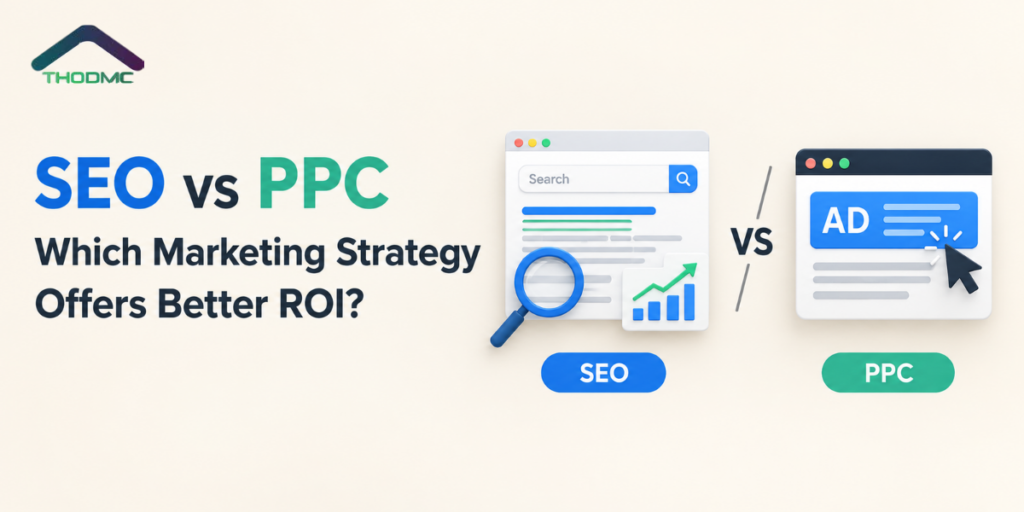
Businesses invest in digital marketing to attract visitors, generate leads, and increase sales. Two common strategies are Search Engine Optimization (SEO) and Pay-Per-Click (PPC) advertising. Both help businesses reach people through search engines, but they work in different ways.
SEO focuses on improving a website’s visibility in organic search results, while PPC helps businesses appear in paid advertising placements. The right choice depends on your budget, business goals, competition, and expected results.
In this blog, we will compare SEO vs PPC, their costs, benefits, and return on investment (ROI) to help you understand which strategy may work better for your business.
What Is SEO?
Search Engine Optimization (SEO) is the process of improving a website so it can rank higher in organic search results. It includes keyword research, useful content creation, technical improvements, website speed optimization, and link building.
For example, a business offering web design services can create helpful pages targeting relevant search terms. With consistent SEO work, those pages may attract visitors from Google without paying for every click.
Benefits of SEO
- Long-term visibility: Well-optimized pages can continue attracting organic traffic over time.
- No direct cost per click: Businesses do not pay Google each time someone clicks an organic result, although SEO requires time and resources.
- Builds trust: Many users value relevant organic results when researching products or services.
- Supports content marketing: Useful articles and service pages can answer customer questions and attract potential leads.
- Improves website quality: SEO can also improve site structure, mobile usability, and page experience.
SEO is a good option for businesses that want to build a steady online presence and attract relevant visitors over the long term.
What Is PPC Advertising?
Pay-Per-Click (PPC) advertising is a digital marketing method where advertisers pay when users click on their ads. Google Ads is one of the most widely used platforms for PPC campaigns.
Businesses can target specific keywords, locations, audiences, and customer needs. For example, a company offering digital marketing services in Ahmedabad can run Google Ads for relevant local searches and direct visitors to its service page.
Benefits of PPC
- Faster visibility: Ads can appear in search results after a campaign is approved and launched.
- Budget control: Advertisers can set daily budgets and manage bids.
- Targeted traffic: Campaigns can focus on particular locations, keywords, and audiences.
- Measurable performance: Businesses can track clicks, leads, conversions, and advertising costs.
- Flexible testing: Different ad messages and landing pages can be tested to identify what works.
PPC can be useful when a business needs enquiries quickly, is promoting a limited-time offer, or wants to test demand for a product or service.
SEO vs PPC: Key Differences
SEO and PPC can both attract potential customers, but their cost structures and timelines are different.
Factor | SEO | PPC |
Traffic source | Organic search results | Paid advertisements |
Initial results | Usually take several months | Can begin soon after launch |
Cost structure | Content, tools, technical work, and SEO services | Ad spend plus campaign management costs |
Traffic after spending stops | Rankings may continue to attract visitors | Paid traffic generally stops when ads stop running |
Long-term value | Can build lasting visibility | Requires ongoing budget for continued traffic |
Testing speed | Often slower to measure changes | Campaigns can be tested and adjusted quickly |
Best suited for | Sustainable organic growth | Immediate visibility and targeted campaigns |
Neither strategy guarantees results. Performance depends on keyword competition, website quality, campaign management, customer demand, and other factors.
Which Strategy Offers Better ROI?
Return on investment measures the value a business receives compared with the money it invests. The better strategy is the one that produces profitable results for your specific goals.
SEO ROI
SEO may offer strong long-term returns because a page can attract organic visitors over an extended period. Once a website earns good rankings, it may continue generating leads without a direct advertising charge for each click.
However, SEO involves upfront and ongoing costs for content, technical improvements, link building, and specialist work. Results can take time, and rankings may change.
SEO may be a better choice when your business wants to build authority, attract regular organic traffic, and reduce its dependence on paid advertising over time.
PPC ROI
PPC can deliver a faster return when campaigns reach the right audience and convert visitors into customers. Businesses can measure how much they spend to generate a lead or sale and adjust campaigns based on performance.
However, high competition can increase click costs. If visitors click ads but do not convert, the campaign may lose money.
PPC may be a better choice when you need leads quickly, have a clear advertising budget, and can track conversions accurately.
Important: Higher traffic does not always mean better ROI. A campaign with fewer visitors but more paying customers may be more profitable than one with thousands of visits and no sales.
How to Calculate SEO and PPC ROI
You can compare both strategies using the same basic formula:
ROI = (Revenue − Total Marketing Cost) ÷ Total Marketing Cost × 100
For example, suppose an SEO campaign costs ₹20,000 and generates ₹60,000 in attributable revenue. Its ROI is 200%.
Now suppose a PPC campaign costs ₹30,000 in total and generates ₹75,000 in attributable revenue. Its ROI is 150%.
In this example, SEO has the higher ROI. These figures are illustrative, not industry averages. Actual results depend on revenue attribution, conversion rates, customer value, and all campaign-related costs.
For a fair comparison, measure both strategies over an appropriate period and include the costs of content production, agency fees, advertising spend, and campaign management.
Can SEO and PPC Work Together?
Yes. Many businesses use both strategies to reach customers at different stages of the buying journey.
SEO builds organic visibility through useful content and optimized service pages. PPC brings paid traffic to selected offers, products, or high-intent landing pages.
For example, a business can use PPC to test which search terms generate enquiries. The findings may help guide future SEO content. At the same time, organic search can attract visitors who are researching a service before making a purchase.
A combined strategy can help businesses reach more relevant audiences, test messaging, and reduce reliance on a single traffic source. The budget should still be allocated according to measurable performance.
How to Choose the Right Strategy for Your Business
Consider these factors before deciding:
- Choose SEO if your main goal is long-term organic visibility and consistent search traffic.
- Choose PPC if you need immediate visibility, quick campaign testing, or leads for a time-sensitive offer.
- Use both if your budget supports it and you want to balance long-term growth with short-term opportunities.
- Track conversions to understand which channels generate qualified leads and actual sales.
- Review your budget regularly and invest more in the channels that produce profitable results.
Your industry, competition, average customer value, and sales cycle should also influence the decision.
Final Thoughts
SEO and PPC offer different advantages, and neither is automatically better for every business. SEO can build long-term organic visibility, while PPC can generate targeted traffic more quickly. The better ROI depends on your business goals, campaign costs, and ability to convert visitors into customers.
For many businesses, combining SEO and PPC can create a balanced digital marketing strategy. If you want to improve organic rankings, generate qualified leads, or manage paid campaigns, THODMC (The House of Digital Media Creator) offers SEO and performance marketing services to help businesses work toward their digital growth goals.
FAQs: SEO vs PPC and Marketing ROI
Which is better for ROI, SEO or PPC?
SEO can offer better long-term ROI by attracting organic traffic over time. PPC can deliver faster results when campaigns target the right audience. The better option depends on your budget, business goals, and conversion rate.
How long does SEO take to show results compared to PPC?
SEO usually takes several months to show noticeable results, depending on competition and website quality. PPC can start generating traffic soon after ads are approved and launched, but leads and sales depend on campaign performance.
Can SEO and PPC be used together?
Yes, SEO and PPC can work together. SEO builds organic visibility, while PPC brings targeted traffic through paid ads. Businesses can use both strategies to reach potential customers and measure which channels generate better results.
Which is better, PPC or SEO?
Both PPC and SEO can help a business attract customers. PPC is better for getting quick traffic and leads through paid ads, while SEO is useful for building long-term organic traffic and online visibility. The right choice depends on your goals, budget, and timeline. For many businesses, using both strategies together can deliver better results.
Can SEO reduce the need for paid advertising?
Yes, strong SEO performance can attract more organic traffic and reduce reliance on paid ads for some keywords. However, PPC can still help with competitive searches, product launches, and time-sensitive offers. Both strategies can work together.